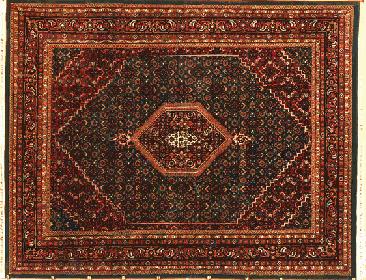
bidjar
named for the iranian city of bidjar, these carpets are rich in history and tradition. the rugs were originally made by kurds using strong hand-spun wool and senneh knots, making the quality of bidjar rugs extremely high. bidjar rugs are firmly and closely knotted, making them extremely hard-wearing. because of their durability, bidjar rugs are nicknamed the "iron rugs" of persia.
the semi-floral and nomadic patterns make the rugs of this region very popular. bidjars are typically dominated by red and blue tones with at least one large border and three to eight smaller borders within the pattern.
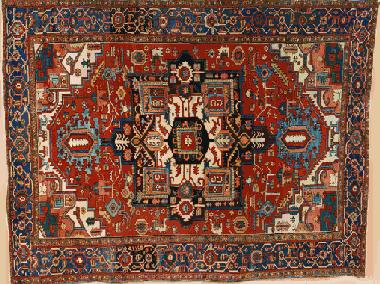
heriz
early heriz patterns are known as serapi carpets. the silk serapi rugs were originally made in the heriz region in a village just north of tabirz in northwest iran. currently serapi carpets are one of the most recognized and sought after carpets in both europe and north america. the simplicity of the serapi geometric pattern, its angular vines, and floral tendrils make the serapi pattern very attractive.
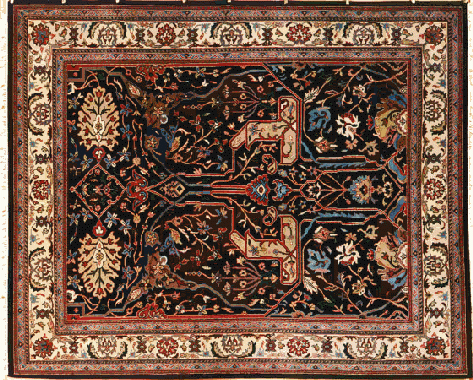
khorason
khorasan is an extremely large province in northern iran. the label khorasan is normally only given to antiques from this area as this region is no longer producing rugs. modern rugs from this province are labeled meshed given the influence of afghanistan on the region.
khorasan carpets are recognizable by their weft. typically a single thread weft is used, but every seven to ten wefts it is increased to three. this causes the carpet to have a banded appearance. these rugs usually have a decorative herati motif. the herati motif is not enclosed in a central diamond, rather a pattern covers the entire field, with the border decorated with a traditional herati motif. carpets tend to be brightly colored when wooven in the southern part of the province, and subdued colors indicate rugs wooven in the northern part of the province
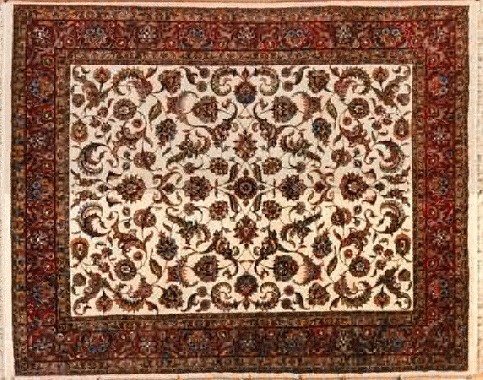
kashan
since the sixteenth century, many fine silk and wool rugs have been woven in this region. these rugs come form a very important district of iran that produces rugs of superior density and firmness. the rugs are made with incredible precision and the silk is so fine that some choose to use them to decorate a wall rather than the floor.
it was only about one hundred years ago that these excellent, hard-wearing carpets came to be made in large quantities. the kashan carpets typically have red or blue backgrounds with a medallion pattern in the middle and corners of the rugs. the background is lushly covered with elegant sprays of leaves and flowers that are beautifully and subtly connected. the borders are blue and contain lotus-flowers.
nain
in the center of iran lies the town of nain which gives its name to the locally woven carpets. nain rugs usually have senneh knots, a foundation of cotton and a pile of wool. these carpets are of exquisite quality as they are very finely and regularly knotted. some of the most expensive and distinguished carpets are of this variety.
the background is typically red or cream with a harmonious design style typical of the small workshop-made iranian rug. the patterns are well balanced due to several small borders which frame the design.